Surgical interventions
 Surgical
All the effort put into rehabilitation aims to help the child learn to walk (independently or with assistance), in other words to control their muscles despite spasticity. However, even if we succeed (…), we are aware that spasticity will cause pain and bone deformities (mainly of the feet and hips) during growth spurts (the bones will grow against contracted muscles). The child will have to fight it all their life. So it is important to list the surgical solutions that exist.
Selective Dorsal Rhizotomy
Among all the possible neurosurgical operations (neurotomy, DREZotomy, rhizotomy, etc.), Selective Dorsal Rhizotomy (SDR, known in French as Radicotomie Sélective Postérieure) is undoubtedly the one that has advanced the most. It aims to reduce muscle spasticity by cutting off the abnormal nerve signals reaching the brain.
The basic technique is not new, but its use in treating children with cerebral palsy is growing in English-speaking countries and it is available in France in a growing number of places. There are two very different ways of looking at the goals of this operation:
- The one favoured in North America, which considers that neurosurgery is indicated for children from a very young age (two and a half) before orthopaedic deformities appear. However, this operation is reserved for children with Little’s pattern (mainly affecting the legs: a mostly diplegic form) who can walk (with or without help), so that post-operative rehabilitation can be effective.
- The one adopted in France, which reserves surgery for extreme situations, when all other treatments have failed. Post-operative rehabilitation then offers no hope of learning to walk and only aims to improve comfort. It should be said that some professionals still tell parents this, but the approach has changed a lot in recent years and increasingly advocates early, preventive surgery.
By removing spasticity, early surgery limits the development of orthopaedic deformities and increases the potential to learn to walk with a correct motor pattern.
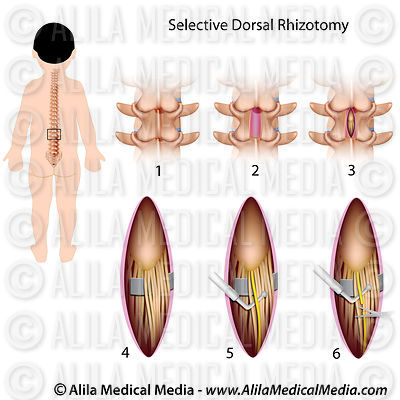
The operation consists of cutting, inside the spine, the sensory (not motor) nerves linked to the leg muscles affected by spasticity. In practice, the neurosurgeon tests each nerve with an electrical stimulus and then cuts those with an abnormal response.
While this operation permanently removes most of the spasticity, it does not improve the shortening of muscles and tendons, which will always need daily stretching.
The results are impressive (and numerous): this video shows the progress of little French champions who took the plunge after hearing our story. We are proud to have contributed to their better future!
The world specialist in this operation was Dr T.S. Park of St. Louis Children’s Hospital (Missouri, USA). Sadly, he passed away in 2024. Dr Park developed a minimally invasive technique that set him apart. It allowed him to open only one vertebra (instead of 3 or 4), limiting the risk of post-operative scoliosis. He operated on more than 4,000 children over 30 years.
This presentation explains the ins and outs: http://www.youtube.com/watch?v=3g7poXxkUow
SDR can do nothing for dystonia. If dystonia is significant, it may even rule out the operation.
Candidates for this operation are children with forms of diplegia (Little’s pattern) whose legs are relatively strong (they need to be able to crawl on all fours and take a few steps with or without help). The motivation of the patient and their family must also be enormous, especially regarding commitment to the post-operative rehabilitation programme. Rehabilitation is crucial to the success of the operation. It is a thankless period that requires daily work (several hours a day), during which progress is sometimes hard to see despite all the effort involved. But read our testimony at the bottom of this page: it is worth it!
Families’ testimonies seem unanimous (see the Facebook group “Selective Dorsal Rhizotomy – St. Louis Children’s Hospital”, where parents post before/after videos). They also report that the operation benefited the arms of their quadriplegic children.
All of EnoRev’s children were operated on in the United States, because the operation was not available in France at the time. But it is finally developing in Europe!
- In Germany, Dr Haberl performs single-level Selective Dorsal Rhizotomy, inspired by Dr Park’s method, which he went to observe in the US. He has a few hundred patients to his name. The operation costs about €20,000 in Germany. Many French families have turned to him (see the associations Un pas Pour Mathieu or La Ronde d’Adrien for the pioneers). Here are his contact details:
Schön Klinik München Harlaching
Ms Tina Hochdorfer (consultations)
Tel.: +49 (0)89 6211-2071
Fax: +49 (0)89 6211-2072Schön Klinik Vogtareuth
Ms Imke Arbinger (SDR)
Tel.: +49 (0)80 3890-2449
Fax: +49 (0)80 3890-3449Note that although Professor Haberl speaks perfect French, neither secretary does. Contact them in English or German.
- In France, Professor Haberl has trained two teams of French surgeons, at the Fondation Rothschild and at the university hospital in Nice. This means the operation is covered by French social security! To be operated on in France by Prof. Haberl and his team, apply to the Fondation Rothschild or Nice University Hospital, sending videos of your child and X-rays of the hips and spine. Here are the contact details as of January 2022:
Fondation Rothschild, Paris
25 rue Manin, 75019 Paris, France
Ms Yohanna RENARD, medical administrative assistant
Paediatric Neurosurgery Department: Dr BONHEUR, Dr DORISON, Dr D’HARDEMARE
Tel.: +33 1 48 03 68 17
Hôpital Universitaire Pédiatrique Lenval, Nice
SDR consultation
Dr N. Chivoret — +33 4 92 03 03 92
chivoret.n@pediatrie-chulenval-nice.fr
secretariat.viscerale@pediatrie-chulenval-nice.frIt should be said that the French medical community sometimes remains very reluctant and struggles to admit that single-level SDR is different from the more invasive multi-level approach. And even if some claim to perform single-level surgery, not all surgeons get the same results. So be careful…
You can visit www.sdrchangeslives.net for very comprehensive information on SDR, especially as offered in St. Louis, and on cerebral palsy in general.
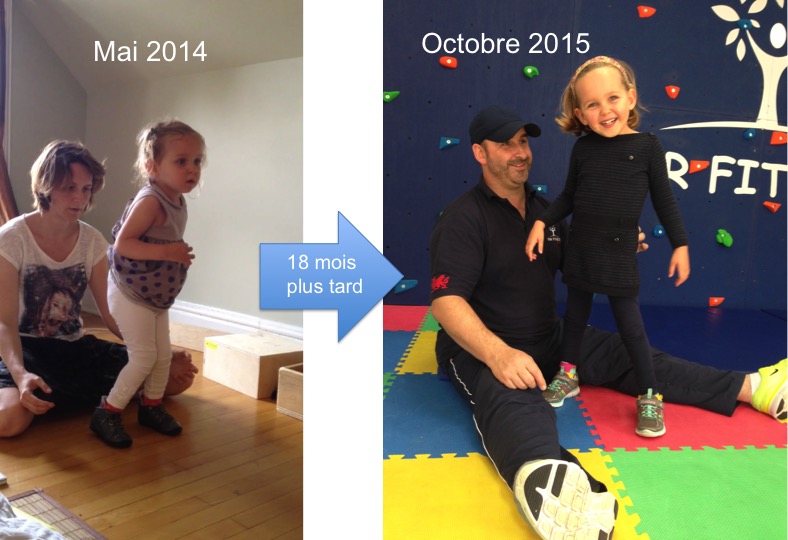
The association’s 4 ambassadors had SDR in the United States (the operation was not widely available in France at the time):
- Enora (A.), operated on by Dr Park in January 2015: What did she say the day after the operation? “My legs don’t hurt any more.” And yet she had never complained before… For good reason: pain was all she had ever known!
The results were stunning: the spasticity disappeared completely, as did the clonus and the equinus. Her legs are straight, her flexibility is that of a child without the condition, her speech has improved (a recognised side effect), she no longer systematically W-sits, and her hyper-emotionality has decreased because she is much more at ease in her body. Her steps are smoother and faster.
It doesn’t solve everything, because the brain is not repaired, but what a joy to put her feet down flat! And thanks to that, our daughter can reach her feet to take off her socks!
- Enora T., operated on in July 2016: . Her testimony (here) shows an undeniable improvement in quality of life.
For those considering this operation, we have published a book, on the advice of a psychologist, to prepare little ones for SDR. You will find it here.
- Enora (A.), operated on by Dr Park in January 2015: What did she say the day after the operation? “My legs don’t hurt any more.” And yet she had never complained before… For good reason: pain was all she had ever known!
Orthopaedic surgery
Orthopaedic surgery in children has three goals:
- to prevent deformities;
- to improve motor function;
- to improve the appearance of the gait.
Orthopaedic surgery includes the following main procedures: myotomy (partial cutting of a muscle) or tenotomy (partial cutting of a tendon), and rebalancing by tendon transfer.
EnoRev’ would like to share 2 pieces of advice:
- French surgeons prefer what they call “multi-site” operations (treating several abnormalities at once) and do not like to operate just for a “fasciotomy”. EnoRev’s recommendation is to consider the psychological impact of overly heavy post-operative consequences. For example, 4 months in hospital away from home after an operation combining SDR, hip surgery and tendon lengthening is clearly the best way to create traumatic memories for your child.
- Many families consult two different surgeons for a second opinion before committing, because opinions are often contradictory. Don’t hesitate to get several opinions!
Myotenofasciotomy or SPML
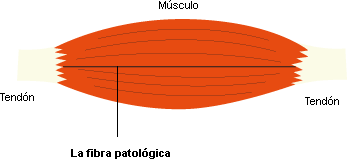
For years, French families of children with brain injuries went abroad for myotenofasciotomy, also called closed selective fibrotomy, or in English Selective Percutaneous Myofascial Lengthening (SPML). This operation consists of making small cuts in part of the fascia (the fibrous membrane surrounding a muscle) in several places to reduce the tension in it.
Looking at the acronym SPML helps to understand what it involves:
- “Selective” refers to choosing the pathological fibres that limit movement.
- “Percutaneous” means inserting the instruments through a puncture in the skin, without surgically opening it. This is possible thanks to a special scalpel developed for eye surgery.
- “Myofascial”: myo means “muscle”, and the fascia is the fibrous collagen membrane that surrounds a muscle.
- “Lengthening” refers to lengthening a muscle; relaxing it means releasing the contractures.
SPML is increasingly popular with families, because the results observed are:
- elimination of local stiffness
- increased range of motion
- reduced pain
- freeing bone growth
- etc.
Good to know: Myotenofasciotomy does not remove spasticity, but it does remove contractures, which are consequences of spasticity. It is not permanent, because of the child’s growth. Its “non-invasive” nature is reassuring. That does not mean it is a trivial procedure: a poor choice of fibres to cut could, for example, cause the arch of the foot to collapse.
The operation is performed:
- in France, in Nice at the Fondation Lenval, by Dr Ghouilem;
- in Spain, in Madrid in a private clinic, by Dr Repetunov;
- in Spain, in Barcelona in a private clinic, by Dr Nazarov;
- in Germany, in Aschau, in a public hospital, by Dr Döderlein.