


Practical ideas.
How many hours have we spent browsing the web looking for good ideas to help Enora with her motor skills? Far too many, no doubt. That’s why we wanted to gather on this page the few “tips and tricks” we came up with. So that they can help others!
Here are the different categories covered:
Daily life
Carrying sling
Imagine trying to lock the door in the morning with a 10 kg little girl in one arm?! Nightmare…
For children under 12 kg, this sling (Tonga®) is a very compact carrying aid! It fits in a bag or a pocket. Easy to put on, it lets you carry a 2-year-old while protecting your back. Obviously it is not suitable for long distances, but it is very handy for popping out to buy bread, for example!
For children over 12 kg, you need something that covers the shoulder more, otherwise you will get back pain. Two brands in particular: Hotsling® and Sling®


The Scooot
Designed especially for little ones with motor difficulties, and for once it looks good too! The Scooot has 3 modular functions. You can find a demonstration video here
Your little ones can turn into real little explorers!
The video opposite shows Enora T. at 28 months trying the Scooot for the first time. It is really intuitive, and parents are usually surprised at how quickly their child adapts.

Swivel car seat
It seems obvious once you’ve thought of it, but a swivel car seat will truly transform your daily life, especially as the child grows. We even found a brand (Migo®) that also makes a swivel booster seat!

The multi-purpose mat
A classic. We hesitated to mention it because everyone knows it. But just in case…
It folds and unfolds as you like. Perfect for helping a child move on all fours, but also to make a little bench. And it’s cheap (€30): what more could you ask for?
You can find it at IKEA. A purchase you won’t regret!


The wireless light switch
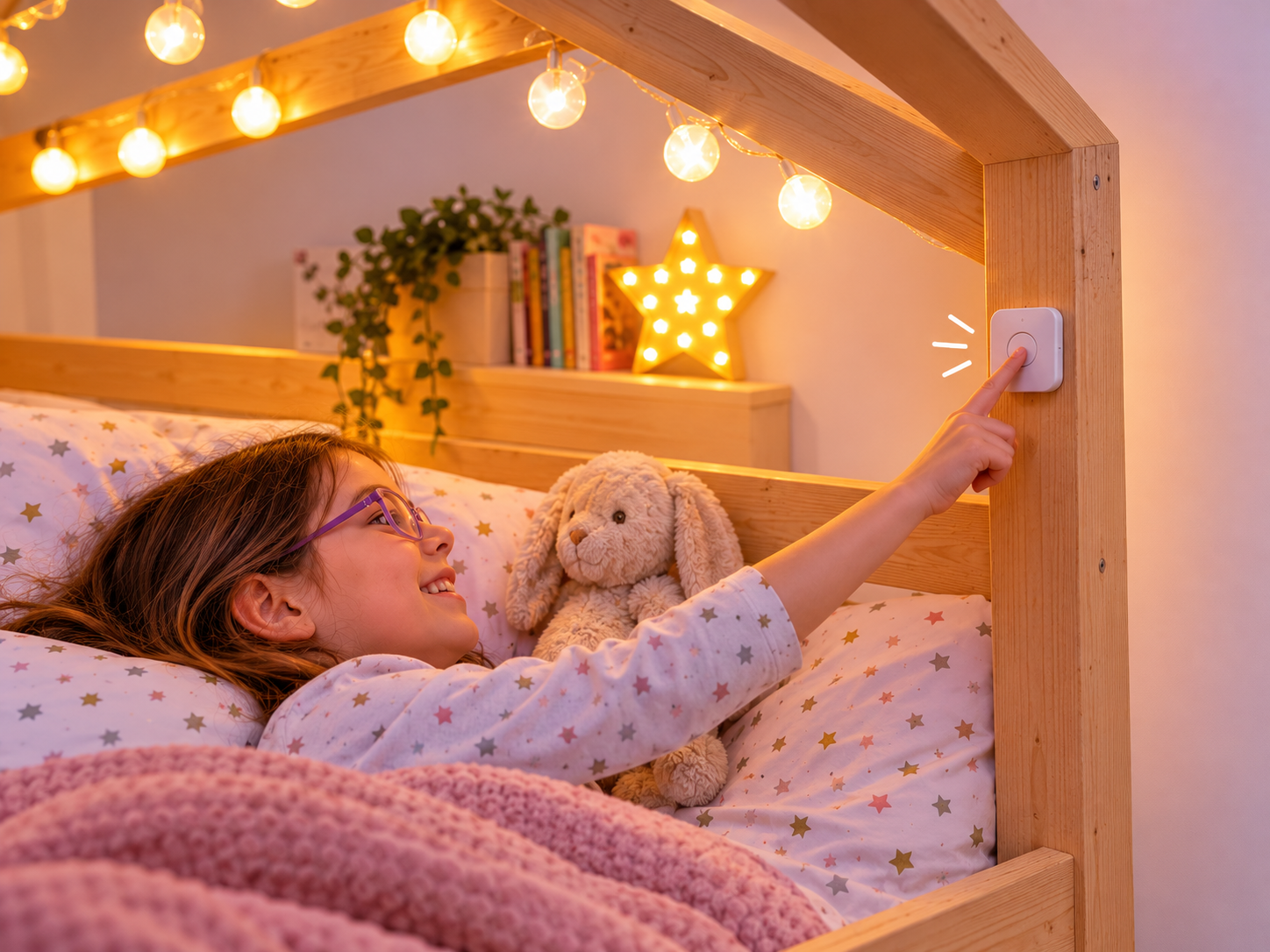
So that Enora can turn her light on and off more easily, we installed a wireless switch on the side of her bed. Simple and effective ! 😉
Shoes that open fully
Putting shoes on over DAFO splints or drop-foot braces can be quite a feat! Shoes that open fully (a zip all the way round the shoe or a 180° opening) make getting dressed much easier.
The zip-up duvet
To stop the child kicking off the covers in the middle of the night and calling us to cover their legs again: a zip-up duvet, which closes like a sleeping bag over the mattress. Models for teenagers are available here (French website).
Walking aids
Home-made parallel bars
To help Enora regain confidence in moving around, we built her some small parallel bars. How proud she is to move on her own!
To build small parallel bars on a budget, all you need to buy is:
- electric fence posts (from a garden centre such as Gamm Vert), cut to the right height for your child;
- 30 or 40 mm drainpipes, drilled in several places but on one side only (not all the way through) to slot onto the posts.


UpSee, the walking harness
Another Firefly product! The Upsee walking harness lets a child walk with the support of an adult. It is not a rehabilitation tool but rather a product that stimulates the child’s development and makes it easier to join in activities while upright. The Upsee comes in 4 sizes, up to about 8 years old, which is why you can often find second-hand ones for sale. Otherwise, it is sold in France by this distributor

Shopping trolley as a walker
At 2–3 years old, Enora refused to use her walker. She was still a bit young to see the point. So we bought a toy shopping trolley, and everything became much more interesting!
Make sure you choose a very stable trolley, not a plastic one! The Melissa & Doug one is sold for €54 on Amazon as a “Shopping Trolley”.


Other ways to use the walker
In the end, we use the walker as often standing still as on the move. It lets us leave Enora (A.) standing on her own in complete safety, especially since the walker has a flip-up seat.
Here are some examples: at the washbasin, at the sandpit, or even on the treadmill!


The walker hammock
Walkers are sold with a “flip-up seat” option so the child can sit down if needed. Here is a cheaper and, in our view, more practical tip: a simple fabric hammock! The child can sit down without having to turn round to lower the seat. Same when setting off again: no need to lift it before walking. Much faster in the playground to keep up with friends!

Soft handles
To help Enora work on her balance, we used small soft handles made from corks and a bit of string. The longer the string, the harder it is!


Wheelchair tips
Home-made armrests
Enora A. has an active wheelchair, meaning it is light enough for her to push herself indoors. Outdoors, however, she uses a power add-on driven with a joystick. For that, she needs an armrest for her arm. Some of you may already have found this out: wheelchair armrests are bulky and make manual pushing impossible!
Our solution was to cut a yoga block with a craft knife to make arm supports, which we attached to the armrests with Velcro. Handy and cheap!


Front castors
To avoid getting stuck in holes and to get over obstacles more easily, we recommend replacing the wheelchair’s front castors with larger ones. For Enora A.’s wheelchair, we chose 6-inch castors, i.e. one (or two) sizes up from the original ones! Make sure the diameter is still compatible with the forks.
And to make the wheelchair more appealing, why not fit light-up wheels? These were bought online from this American website: Volcanic Wheel


The waterproof leg cover
Super practical and well made, this waterproof leg cover protects from rain and cold during wheelchair outings. It folds away easily under the wheelchair, so it is always to hand! You can find it here (Amazon France).
The heated leg warmer
When sitting in a wheelchair, the legs move very little and get cold very quickly. This heated leg warmer is the answer to frozen legs! You can find it here (Amazon France).
Leisure
Joëlette
So as not to give up hiking, the Joëlette (an all-terrain single-wheeled chair) is a particularly interesting product.
Enora A. is especially proud to be able to take part in running races thanks to it, and it also allowed her to take part in an orienteering race in the mountains with her secondary school! This equipment is expensive, but many associations lend or rent it out.
And for younger children, there is also the all-terrain mini-Joëlette (for children under 30 kg) ! Visit their website !

Skis to glide on snow!
For those who haven’t given up on skiing holidays, these little skis attach to the front wheels of the wheelchair, so it no longer sinks into the snow!
We have found 2 brands: WheelBlade and BBGliss


GoToSki
The Go-To-Ski lets people with disabilities ski STANDING UP. Marc Gostoli is the builder and inventor of this great system.
Standing up and racing down the slopes with the same gliding sensations as an able-bodied skier is better than a dream!
It is based at La Pierre Saint-Martin (a ski resort in the Pyrenees) and run by the association La Pierre Handis Pyrénées, which has 3 sizes, from toddler to adult. EnoRev’ is proud to have contributed financially, and other ski resorts are also equipped, in the Alps for example.
Feedback from Clet and his mum: “I watched the instructors being trained, tested the machine and finally became a driver myself (to accompany my little one on the snowy slopes!). So many thrills and so much shared joy on the snowy slopes! Always believe in your dreams and do everything to make them come true!!”

Adapting a bike with stabilisers
Enora (A.) has grown up. No more little tricycle: she wants to pedal a real bike with stabilisers. We made a few adaptations: a push handle, locking the freewheel (by gluing the sprockets with metal glue) and fitting leg guides to stop her knees turning inwards when she pedals.
The leg guides are made by Vermeiren and cost €180 a pair. Measure the length of the calves to check they are compatible. They are unlikely to suit a child under 99 cm tall.


Feet strapped onto the tricycle!
Of course cycling is good exercise. But what do you do when your little one can’t keep their feet on the pedals? We opted for a simple, effective solution: strapping the feet to the pedals with Velcro! This allowed Enora to start riding a tricycle at 18 months. After each ride, her legs are much more supple.
A tip on choosing a tricycle: it should not have the pedals on the front wheel, as this is harder and does not produce the right movement.
Where can you find strong Velcro straps? We used the ones for bundling computer cables, but there are others. Search for “Velcro” and “cable ties” online.

Neck float ring
Water is an element in which our little ones finally feel free. To encourage their movement safely, there are inflatable neck rings. You can then let go and let them move about freely. What a joy!
In Japan, these rings are used in maternity wards with newborns, but they come in all sizes!


The card holder
To play cards as a family without having to hold a fanned-out hand: a card holder, curved wooden or round plastic. Hands stay free to draw and play!
The book holder
To read without having to hold the book open: a book holder, very handy in the car, for example! You can find it here (Amazon France).
Hygiene and health
Bath
It is not easy to bathe a little one who cannot sit up or is unstable sitting.
You can simply lay your child on their back in a few centimetres of water in a standard bath and let them move their arms and legs freely under your supervision. That’s what Enora (T.) did.
There is also this moulded bath (OK Baby), which has the advantage of a built-in reclining seat on one side and a seat on the other. Your child is well supported and safe. Enora (A.) used it until after she turned 3!


The shampoo visor
Very useful for hypersensitive children who can’t stand water on their face: the visor protects the eyes and face while washing their hair.
3-headed toothbrush
Why didn’t anyone think of it before? So clever! This 3-headed toothbrush helps people with limited dexterity brush their teeth better. Of course, nothing beats an electric toothbrush, but hypersensitive children don’t always tolerate them.


Dietary fibre
Most of our little ones suffer from constipation because of weak abdominal muscles. We discovered Optifibre, a dietary fibre sold as a completely tasteless powder.
It can be added to hot or cold drinks as well as to food. Really effective! Available over the counter in pharmacies.

The folding shower chair
A folding shower chair that is easy to store, and it looks nice too, which is rare for disability equipment! You can find it here (Amazon France).
Stretching and positioning
NADA chair
This flexible strap-based frame lets you sit with your back straight. It can be used on a chair or on the floor with legs straight to stretch them! Not bad for watching TV while stretching, right? 😉
Sold as the “Nada Chair”

Mealtimes
The Bumbo seat
Enora T. cannot yet sit on the floor on her own. She has a moulded shell seat on wheels with a tray, but it is very bulky. This little seat is easy to take anywhere and lets her play at floor level with her brothers!
Our advice: while you’re at it, choose one that can also be attached to a chair! For example, the Ingenuity® one for €46 or the Bumbo Multi Seat®.


Fabric portable high chair
It is not easy to seat our little ones, because they are far from having the trunk control needed to sit up on their own!
For convenience, we chose the “Totseat®” (photo on the left), but there is also the “Gotoseat®” (photo on the right) for little ones who cannot hold up their torso.
The “Totseat®” takes up little space and fits in a handbag (handy at a restaurant, for example). The “Gotoseat®” has a rigid frame and can also be fitted almost anywhere!


Chunky-handled cutlery
To make her cutlery easier to grip, Enora T. uses non-slip chunky-handled cutlery. It helps people with weak hands eat more easily and independently.
Tip: you can find them on websites specialising in ergonomic solutions, but also simply at Intermarché!

Learning knives
Kiddikutter knives have rounded serrations that cut food effectively, but not skin! No risk of cuts. Originally designed for young children, they are useful because they reduce the effort needed to slice, dice and chop. They work with a sawing motion that keeps contact with the food.
They also have a non-slip coating that is easy to grip.


The telescopic straw
A telescopic straw that folds into a small case, to take everywhere (you can find them on Amazon). Handy at restaurants, picnics or friends’ houses!
Share your tip!
Have you also found an object, an adaptation or a little idea that makes your child’s daily life easier? Share it! We will publish the best tips on this page, with your first name, so that they can help other families.