

Orthopaedic solutions & devices.
Orthopaedic devices are mainly used to:
- Prevent muscle and capsulo-ligamentous contractures (fighting changes in the contractile properties of muscle fibres)
- Improve joint mobility
- Make it easier to move around
Depending on their purpose, they can be static or dynamic, soft or rigid.
Dynamic drop-foot brace

We love this! It is normally used for adults, and few professionals know that there are models for little ones!
This device is designed to help walking by lifting the foot, so that the movement starts from the heel rather than the toes. We also see a second benefit: it keeps the muscle permanently stretched. This gives Enora A. more stability, because she can stand against a table with her feet “almost flat”.
http://www.orliman.com/adaptingshop/usuario/productos/fichaproducto4.asp?idproducto=3542
Daytime DAFO orthoses / splints


Despite good shoes, Enora A.’s feet and knees kept collapsing inwards. Simple orthopaedic insoles proved ineffective, and we were worried about bone deformities. Heel braces are what really corrected her stance. They hold the calcaneus (heel bone) firmly in place and support the arch to prevent it tipping into valgus. They can be made in different ways, but the function is the same (see pictures below).
More generally, and for a wider range of conditions, we recommend taking a look at this excellent guide by Cascade, which you can download here
Night splints or orthoses


Here is the first static model that Enora A. tried.
At first we gave up on them, because we noticed that her muscles were “fighting” against the anti-equinus splint during the night. This left very marked red marks where the straps were.
In the end, we opted for dynamic orthoses, i.e. articulated splints that allow an extra degree of rotation. To complete the stretch, they are combined with a knee splint that keeps the knee immobilised.
Of course it breaks our hearts to have to use this, but we can see that it works. As it is a bit “barbaric” and above all hard to sleep with, here is our trick: we only fit one leg per night (alternating every other night). The first nights are hard, but with regular use it is well tolerated.
Moulded shell seat


A shell seat was designed to keep Enora T. in a good posture. To make it more practical, a small tray was added.
A good sitting position frees the hands for play and also helps position the tongue better for eating!
While this type of seat is useful to help the child use their upper body, keep in mind that the child should not spend all day in it. Letting your child play lying on the floor will encourage their gross motor skills.
Cross-legged seat


A moulded seat was designed to keep Enora T. sitting cross-legged. Spasticity prevented her legs from staying in this position.
Very useful for nursery rhyme time on the floor at the nursery, for example!
Posterior walker

Enora A. first tried a classic anterior walker (the kind you push). But it did not feel safe, because we always had to stay behind her in case she fell. So no gain in independence!
Shortly before she turned three and a half, we offered her the “Crocodile”. It is a reverse (posterior) walker that sits behind the child, which makes it safer.
This configuration also makes it easier for the child to access different activities. We added a small flip-up seat (optional) so that Enora can rest if she needs to.
But how do you get a little Enora with stubborn Breton roots to accept a walker? The answer in pictures: by stirring her curiosity!
The Motilo


The Motilo is a walking aid made of an adjustable corset-saddle mounted on a wheeled frame.
Let’s be clear: this “baby walker for big kids” lets the child move around safely, but it has no rehabilitation value from an orthopaedic point of view. In particular, it has two major drawbacks that can be partly overcome:1. Because the back wheels are not locked straight, the child places their feet any old way and does not direct their push. The child often scuttles sideways like a crab. It was really obvious with both Enoras! As a result, the walking pattern is really poor. To fix this, lock the back wheels straight: at first, children often push with both feet at the same time, then gradually the locked wheels encourage them to dissociate their legs.
2. Because of the support it provides, the torso tends to slump. The child’s upper body is passive and often sags to one side. Adding the tray, set high, lets the child lean on their forearms.
For an illustration, see this testimonial (in French): http://www.nouveaux-pas-pour-lucia.org/mon-materiel.php
What we haven’t told you is that Enora A. flatly refuses this kind of device. She does not see it as a tool for independence. To be honest, our house is not really suited to it either. You need space, and the right furniture too, because the handlebar stops Enora A. from reaching her toys when she is in the Motilo. In a school playground, it would really come into its own!
As for Enora T., Miss loves trying out standing up. Imagine all the potential mischief that suddenly becomes possible! You can reach the plants, the TV… Brilliant! But in the end, her Motilo was swapped for a Bison.
The active, lightweight wheelchair


Some parents keep using a pushchair for as long as possible because they are not ready for a wheelchair. For our part, once she was over 3, we felt it was probably better for her self-image not to be seen as a “baby” in a pushchair, especially with school starting and her classmates. And we were fed up with hearing busybodies say “Come on, lazybones, you could walk!”. No comment…
And independence is priceless. We are so proud to see our little one zoom off to the toy aisle when we go shopping!
Our recommendation: choose an active, lightweight, easy-to-handle paediatric wheelchair that can grow with the child. More basic wheelchairs are cheaper, but they are so heavy that the child struggles to propel themselves, and your back cries out every time you have to lift it into the boot!
The first try was so intuitive that both Enoras immediately understood how to handle it! Needless to say, the parents are delighted they turned down the heavy wheelchair with a moulded shell that was first offered to them!
The Flex Corp

A soft, fairly discreet orthosis to help improve postural alignment. Velcro straps apply a gentle external force to correct poor positions. This provides gentle sensory retraining of the neuromuscular system, making the torso and joints more stable thanks to constant input.
The orthosis has two parts, one for the torso and one for the pelvis. For Enora A., only the shorts were recommended, to encourage external rotation of the knees by acting gently on the adductors, and to open the pelvis by slightly stretching the glutes.
Honestly, we did not see a major effect with this type of orthosis. But perhaps it depends on each child’s condition?
The Ottobock shorts
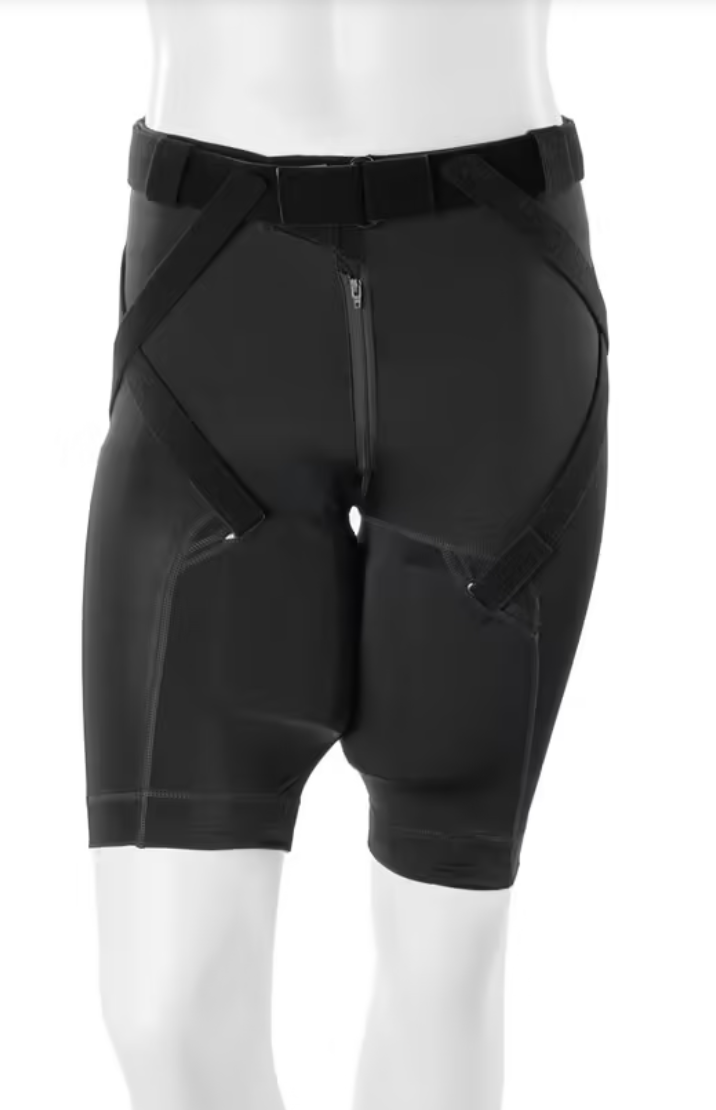
These shorts include a hip abduction pad. This is useful for several reasons:
- At night, to avoid moulded mattresses or other static, uncomfortable abduction solutions.
- For children with a scissor gait, it stops the knees from crossing.
- To avoid needing an abduction block in a wheelchair or other seat.