The children, their story
 The
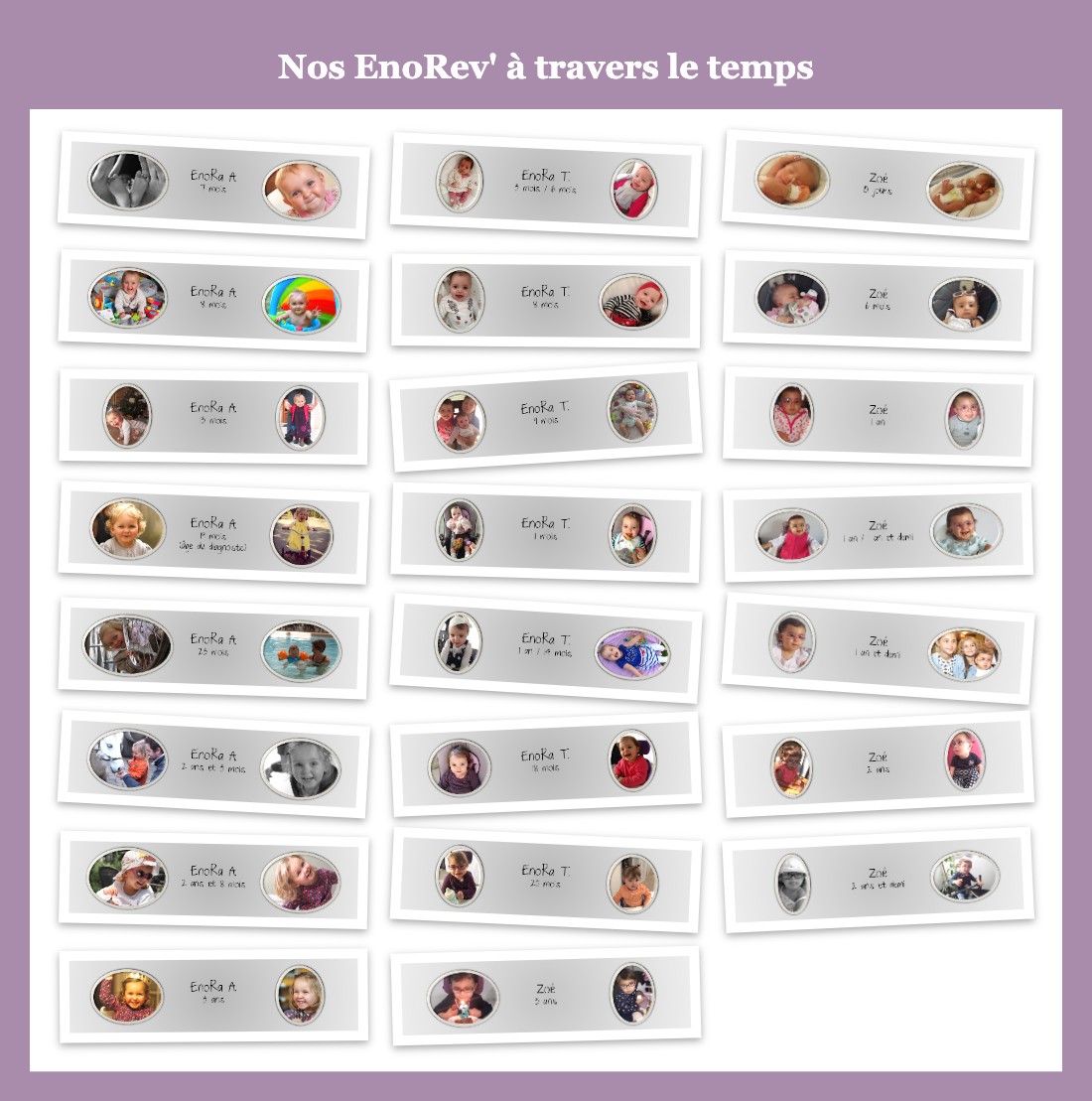
Discover the story of our 4 little ambassadors, scattered across France. They share their experience with you:


Yes, there are two little Breton girls (one of them exiled in the south) who are both called… Enora! Pay attention to tell them apart in our stories!
Enora A., Toulouse
“Always listen to the parents,” concluded our new paediatrician after hearing our story. “Remember that,” she advised the young junior doctor beside her. May other doctors follow the same advice!
The diagnosis of “spastic diplegia” was only made when Enora was 19 months old, even though we, her parents, had been telling doctors about suspicious stiffness for a long time.
At the 9-month check-up, the paediatrician ticked “yes” in every box of the health record without even listening when we explained that, no, she was not crawling.

At 12 months, thanks to a physiotherapist who was not swayed by her tears, Enora learned to crawl with alternating limbs. Tough but effective.
At 14 months, we consulted an orthopaedic surgeon (well known in Toulouse) about a pronounced valgus affecting both feet and the fact that Enora could not stand up. “Madam, all parents want their child to walk as early as possible. Leave her alone, she’ll walk when she wants to. And come back and see me when she has been walking on her own for 6 months.” Needless to say, we never saw that gentleman again, but he made us lose precious months by making us doubt ourselves.
At 18 months, our paediatrician at the time finally decided to refer us to a neuro-paediatrician. Convinced it was an orthopaedic problem, we had no idea what lay ahead… We were told that Enora’s clinical picture was consistent with spastic diplegia, otherwise known as Little’s disease.
We were immediately referred to a multidisciplinary rehabilitation centre, which offered 2 physiotherapy sessions a week. “Only two?” I dared to ask. “Madam, I don’t think you realise that you are in for years of rehabilitation. You mustn’t wear yourself out from the start, and neither must Enora.” We later understood that “not too much” was this centre’s philosophy. That is what led us to leave it 5 months later, once we had found our feet in this new world: the world of disability. Enora was then turning 2.
Since that day, we have been racing against the clock to make use of the brain’s plasticity, which is particularly malleable in young children. And we are determined!
We put in place a real “battle plan” (see “Progress made”) which helped her progress. After a year, at 3 years old, Enora A. could:
- ride a bike with stabilisers,
- walk while held by one hand only,
- stand still for 30 seconds,
- take 3 steps on her own.
None of this would have been possible without all the effort we put in. And the progress would have been far greater if we had started younger!
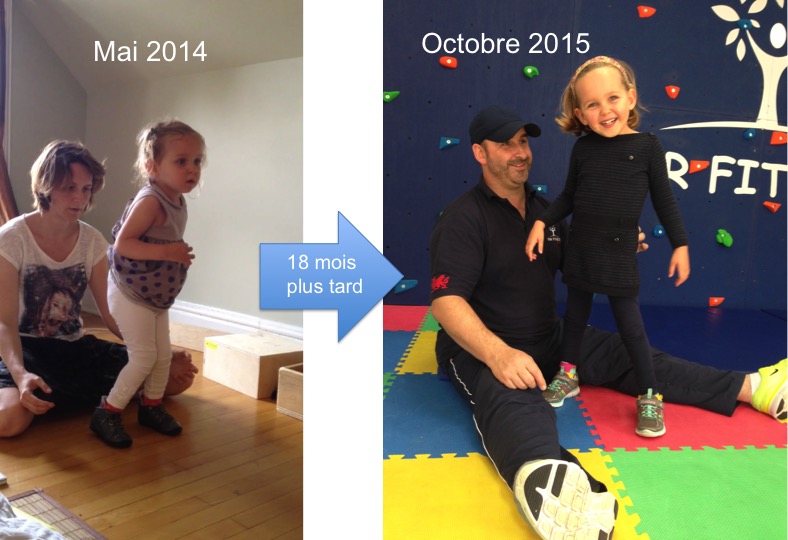
Unfortunately, growth and spasticity do not mix well, and this progress was wiped out when she started nursery school and we could no longer devote as much time to rehabilitation.
That is why we turned to an operation little known in France: single-level Selective Dorsal Rhizotomy. Yes, contrary to what our neuro-paediatrician told us, we can assure you: there really is an operation that permanently removes spasticity in the legs! (for non-degenerative conditions, of course). Quite a scoop, isn’t it? Discover the benefits of the operation here. We were pioneers, as we were only the 2nd French family to have the operation with Dr Park (early 2015). But since then, the good news has spread; dozens of children have taken the plunge and French doctors are finally taking an interest! Of course, miracles don’t exist and it does not mean the fight is over, but the odds are a bit more even!
Over the years, the goals we had set ourselves have changed, because we had to fit around school. It has always been important to us for Enora to attend a mainstream school, because inclusion helps our daughter progress, but also the other children, the citizens of tomorrow, and therefore society itself! So her timetable is a careful mix of school time and therapy (which we try to schedule after 4 pm so that neither suffers).
Enora is now 11 and has started secondary school. She has been diagnosed with dyslexia and dysorthographia, which requires adjustments (shorter or fewer exercises, gap-fill dictations, use of a computer, etc.). Thanks to all this, she keeps up with her friends and gets top commendations every term!
What about her motor development? The pace is intense, because we know adolescence is a critical period, with big growth spurts that undo progress. We go on intensive programmes during the school holidays. We focus on independence by working on transfers. Enora uses a wheelchair at school (a manual wheelchair with a power add-on since secondary school) and a walker at home.
Since 2020, we have known more about the cause of her disability. She does not actually have cerebral palsy but rather a genetic condition called hereditary spastic paraplegia. Yet more jargon to get to grips with…
Enora T., Rennes

Enora T.: our little Enora was born at 29 weeks… just 6 months into the pregnancy.
Her prematurity left after-effects, but contrary to what some doctors implied, we chose to fight to give her the very best!
A few emails with Gwenaëlle, Enora A.’s mum, and we joined the association. This is where it all began:
We started the MEDEK method in September 2014, and our little one made progress day after day!
Thanks to Medek, which we did in sessions in Toulouse with Océane Javaux, a physiotherapist, Enora, who could not sit up at all, sat for 1 minute for the first time after 4 sessions (she was 16 months old)… As you can imagine, after such amazing progress, we had no intention of stopping there!
So we kept going, 45 minutes at home every day, and several sessions went by until suddenly Enora started to crawl… It was November 2014, and Enora was 18 months old!
We never gave up and put more and more therapies in place to find the right balance…:
- Conductive Education at La Maison Escargot (22)
- Medek (Toulouse, then Lyon)
- Vojta method (Rennes)
- Swimming pool
- Bobath physiotherapy


And it paid off: in August 2015, Enora T. started crawling on all fours. She was 27 months old…
In December 2015, she climbed the stairs on all fours (31 months)
At the end of June 2016, following in Enora A.’s footsteps, Enora T. had a Selective Dorsal Rhizotomy (at 3 years old), to our great joy.
Straight afterwards, Enora T. discovered her new, supple body; she could reach her feet on her own, which was impossible before the operation. After 3 weeks of post-operative rehabilitation, she could use a walker to take a few steps on her own. The beginning of independence!
A lot of rehabilitation lies ahead, but we are not afraid; we will give everything it takes to give her the best.
Today, Enora T. is a little girl full of life, curious, with a strong character, a real little rascal! It is her determination that will take her forward.
Zoé, Pas-de-Calais

Our little Zoé was born prematurely at 32 weeks on 12 January 2014.
The months went by and my mother’s instinct told me something was wrong. Of course, everyone, including the doctors, told me “wait! She’s premature!” But deep down I knew…
After an MRI and various appointments, the diagnosis came: cerebral palsy resulting from periventricular leukomalacia lesions, asymmetric spastic tetraparesis predominantly on the left.
After the shock of the diagnosis, we decided to fight! Zoé is stimulated at home and also at nursery.


- From 4 months: physiotherapy for a torticollis, followed by stimulation…
- 11 months: Zoé joined the CAMSP (early intervention centre): physiotherapy twice a week (45 min)
- 12 months: Zoé got her first glasses, which allowed her to discover her toys!
- 18 months: Zoé rolled over for the first time
- 28 months: Zoé sat up for a few minutes
- 33 months: botulinum toxin injections in the abductors and the medial and lateral gastrocnemius, then 4 months at the “Marc Sautelet Villeneuve d’Ascq” rehabilitation centre.
- 34 months: she can now move around with an “Orchidée” (a sit-on crawling aid); she is starting to get into the all-fours position but cannot yet move forward.
- At 35 months, Zoé joined the EnoRev’ association and we started the Medek method!! With this method, we finally feel that Zoé’s rehabilitation is moving forward!
2017: Zoé is a very smiley, motivated little girl who loves to talk! Yet her joy of life is affected by constant painful muscle contractions that cause orthopaedic deformities and get worse as she grows.
After letters, videos and photos, on 20 April 2017 we received a letter from Dr Park stating that Zoé was a good candidate for an operation that could change her life: Selective Dorsal Rhizotomy. It aims to reduce muscle spasticity by cutting off the abnormal nerve signals reaching the brain. Zoé’s operation took place successfully on 23 January 2018 in the United States. She can finally straighten her legs and put her feet flat! (she had equinus feet before).
However, spasticity had already done damage by causing muscle contractures that limit her range of motion. So a 2nd operation (a minor one this time) took place on 1 February 2018 to lengthen the tendons behind the knees and… the ankles.
Zoé now has supple, pain-free legs, which is huge, isn’t it? … she deserves it so much…
What’s next? Learning to control this new body again with targeted rehabilitation. It may take months, even years!
2019: In October 2019, we went to Marzenia in Poland for two weeks of intensive rehabilitation. Our first intensive programme. It was a revelation! In those two weeks, Zoé learned to walk very long distances with her walker. The Lokomat, a gait-rehabilitation robot, played a big part, but it was part of a daily programme of swimming, pony riding, physiotherapy, Lokomat, art or music therapy, etc. The therapies are much more comprehensive and demanding than in France.
Schooling:2021: This year was marked by toilet training (quite a victory!) and two intensive rehabilitation programmes.
- HABIT-ILE method (research protocol) in Brussels in July 2021, to work on independence. With the therapists, we set the following 5 goals: (1) getting up from the floor on her own, (2) transferring from the wheelchair to the walker, (3) balancing on her own, (4) transferring from the walker to the toilet and pulling down her trousers, (5) using the walker outdoors. It was a very rewarding programme for Zoé and our family.
- In November 2021, we went to Madrid for Lokomat sessions to build muscle and correct Zoé’s walking pattern. She also had physiotherapy sessions to work on her body alignment.
Today, fear of falling and a lack of self-confidence are holding back Zoé’s motor progress. However, we encourage her every day to push herself, and we are convinced that once she gets past this fear, we will reach new milestones!
Zoé attends a mainstream school and progresses at her own pace despite some difficulties in maths. We added a power add-on to her wheelchair so that she can be more active with her classmates at break time without her assistant’s help, and save her energy for learning!
Clet, Bordeaux


Clet was born at 36 weeks, i.e. seven and a half months into the pregnancy. That’s early, but not so early when you have two brothers. Yes, Clet is a triplet, from a natural pregnancy.
An adorable little thing weighing 2.23 kg. When he was about 3 months old, I realised Clet was not reacting “normally”: either floppy like a rag doll or very stiff. I was worried, but according to the paediatrician I shouldn’t worry, or I would turn him into a spoilt child, and I should give him time, because “just because there are three of them doesn’t mean they have to develop at the same speed…”
Little did he know he was summing up the new tempo of our already unusual family…
At 18 months, we finally had an MRI, which revealed that Clet has cerebral palsy caused by a perinatal incident, resulting in motor delay, mainly affecting the legs.
We quickly understood that our child would only progress with lots of stimulation, and the relentless round of appointments began: three physiotherapy sessions a week, 30 minutes from home. Luckily, granny wasn’t far away and became the official minder of the two brothers. Then very quickly (Clet was 22 months), thanks to a newspaper article, we discovered the world of alternative therapies…

From 22 months to 3 years, we did one programme after another, two to three weeks each, of Conductive Education. We saw our child develop with every session… Clet started crawling, sat up on his own and was toilet trained!
Then, around 3, we discovered the Medek method, and Clet locked his knees for the first time. What a relief when putting his coat on…
When Clet was 5, I started looking into SDR after some Facebook posts. A real journey began: meeting other families whose children had been operated on in Germany and the United States, an application to St. Louis, and a meeting with Professor Haberl! Against the advice of French doctors, we decided that Clet would be operated on by Dr Park in the United States. The date was set: Clet would have his operation on 6 March 2018. He was 6 and a new life began for our champion!
14 months after the operation and many hours of rehabilitation, Clet took a few independent steps during a Medek session. A few days later, he swam three lengths of breaststroke without any help. There’s no stopping him now!! There have been many successes, and the one that benefits the whole family is sleep. Before the operation, he woke up every night because of pain caused by spasticity. Since the surgery, Clet sleeps peacefully, which gives him more energy in the morning for his motor needs, for learning at school and, of course, for a bit more mischief!!!
Our advice? Increase rehabilitation hours in many forms (Medek, Lokomat, muscle strengthening, swimming, pony riding, cycling…) to help your child progress. By combining private therapy and intensive programmes, Clet keeps making progress and is taking more and more independent steps on varied ground! He was born into a new world that he hasn’t finished taming.
Unfortunately, Clet’s walking is not functional. He only walks when prompted by his physiotherapists or parents… Why? Clet is visually impaired. He is short-sighted, which is corrected with glasses, but he also has neuro-visual problems (see the chapter on this subject). On top of that, there is growth, the enemy of tendons, muscles and ligaments. With cerebral palsy, muscles lack elasticity, which creates tension and setbacks. But Clet never gives up, so as not to lose what he has achieved!
Clet is a very happy little boy who makes the most of all the good moments life offers him. Never far from his two bodyguards, his brothers, he’s a fighter, and believe me, he hasn’t shown us everything yet!!!