Rehabilitation methods
 Rehabilitation
On this page, we do not claim to give exhaustive definitions of rehabilitation methods. We present them and give our opinion as users. Because back then, we would have liked to know that we could question the therapeutic approach we were being offered!
Bobath/Le Métayer methods
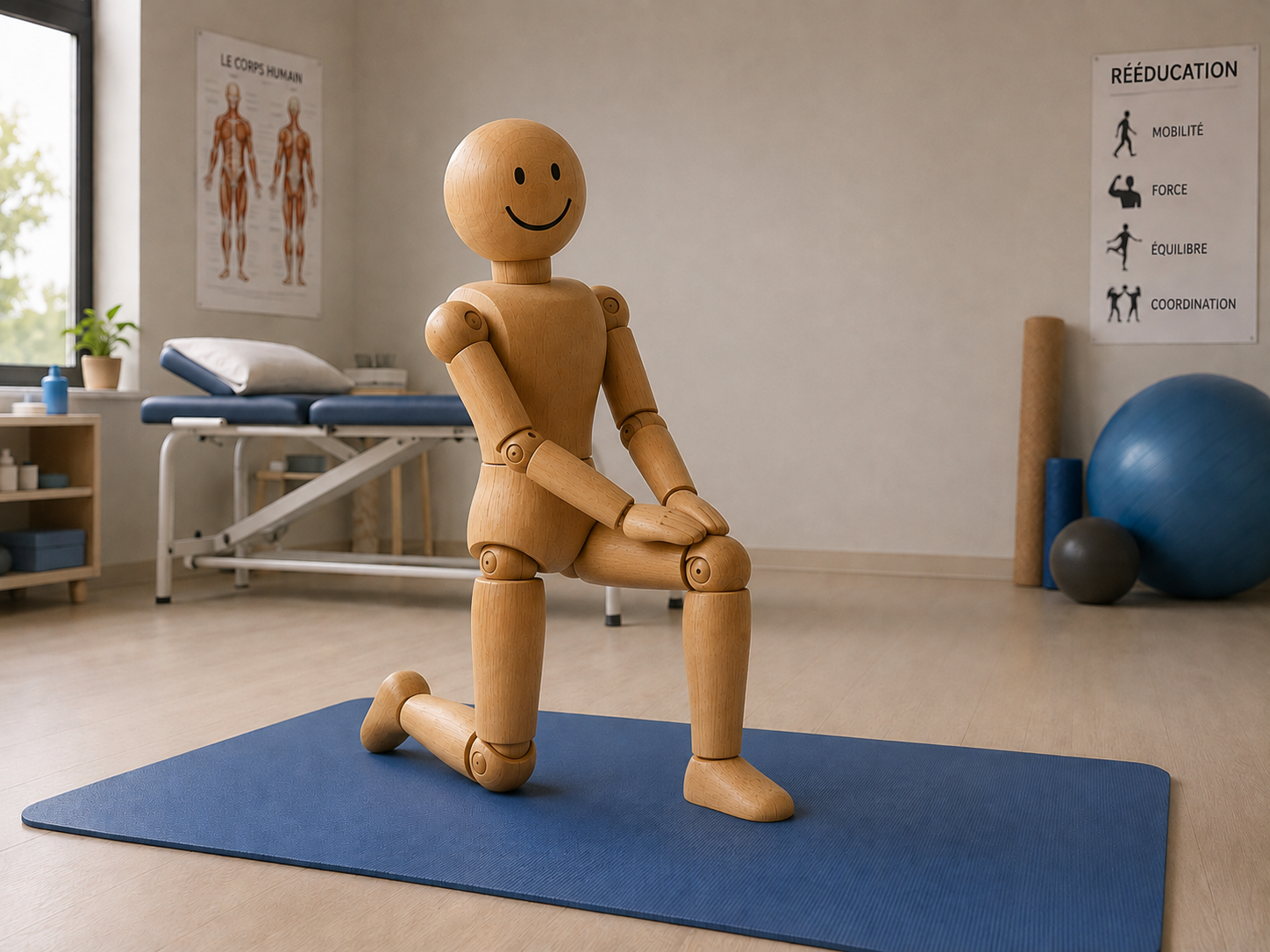
Many of the paediatric physiotherapists we have met (and there have been many…) are quite unable to explain the difference between Bobath and Le Métayer… They (“they” in the broad sense, with the exception of the rare true specialists) seem to practise a mixture of the two, even though the methods are quite distinct.
In theory, the therapist helps the child to experience “normal” movement, in order to broaden their repertoire of sensorimotor experiences and improve the quality of their everyday movements.
In practice, the success of this approach depends heavily on the child’s involvement and character. In Enora A.’s case, she could never bear being forced to perform a movement in a way she found “counter-intuitive”. From 14 to 24 months, physiotherapy sessions boiled down to performing the famous “half-kneeling” position to learn to stand up. A movement she could not do, because she could not put her foot flat on the floor at 90°. At every attempt, she was corrected: “no, not like that”. How can a child under 2, who only wants to play, put up with being corrected constantly? So twice a week, for 10 months, Enora was set up to fail every time. Sessions ended in tears and Enora quickly lost confidence. In daily life, she no longer wanted to try new ways of moving. “Can’t,” she would say. She was the victim of practitioners who wanted to “go through the developmental stages in order”. Until this movement was mastered, we would not move on to anything else. In short, a bitter failure as far as we were concerned.
Today, we have discovered what real, effective Bobath sessions look like… in Poland! But even so, we are convinced that this method alone cannot enable a child to make significant progress in their motor patterns.
Medek method

This motor therapy was a real revelation. The MEDEK method (“M” for motor, “K” for kinetic) is also known as CME (Cuevas Medek Exercises). It was created by the physiotherapist Ramón Cuevas in Venezuela in the 1970s. Its main aim is to “provoke active and automatic motor responses” without relying on the child’s “cooperation and motivation”. A revolution!
The diagram opposite tries to give an idea of the Medek philosophy. The idea is to get the brain to create a postural control response by bypassing the damaged areas of the nervous system. This is done:- by exposing the child to “progressive challenges” in which they must fight gravity so as not to fall. This gradual acquisition of balance teaches vertical control of the head, then the trunk;
- with little or no support (the aim being to move the support as far as possible from the head towards the ankles: this is called “distal” support);
- by practising again and again so that the brain records the movements.
Two other aspects set it apart from traditional approaches:
- The Medek method includes dynamic stretching exercises built into the functional exercises. They are undeniably far more effective than static Bobath stretches!
- Hypertonia in the lower limbs (equinus feet for Enora) does not prevent standing from being stimulated. In other words, the Medek method gets the disabled child standing in order to develop vertical trunk control.
The video opposite explains the theoretical foundations of the approach, then, in a second part, videos (featuring Enora!) are shown.
When Enora tried this method at 21 months, after only 6 sessions we saw her standing for a few seconds for the first time. Enora regained confidence and “dared to take small risks” when moving around. This method requires huge commitment from parents, who are taught the exercises by the therapist to repeat them at home twice a day for 45 minutes, 6 days a week. Time-consuming? Certainly, but it is worth it.
The progress is there and visible from the very first sessions.
The limits of this method are set by the child’s height and weight, because the practitioner needs a strong back and some muscle! Start as early as possible, because after 4 it becomes very hard to begin.
We are eternally grateful to Ester Fink, the therapist who introduced us to this method, and to the association “Avance avec Hermance”, which organised the sessions in Toulouse. Since then, the landscape has changed: more and more associations organise sessions and new professionals have trained.
Where to practise Medek near you?
- With French Medek practitioners: More and more therapists practise Medek in France. There are now about fifteen of them! Don’t hesitate to contact them, they are all very competent! You will find their contact details by clicking on the map.
- With Medek therapists from abroad: Many associations go to great lengths to invite Medek therapists to bring out the full potential of our little ones!
Here is a map of France showing the cities where you can find regular Medek sessions.
DMI method
The DMI method (Dynamic Movement Intervention – https://dmitherapy.com/)) is inspired by the Medek method. It was created by Canadians (originally level 3 Medek/CME therapists, so highly experienced) who are working to provide scientific evidence for the method and so demonstrate the benefits of this rehabilitation. It is true that, as families, we are personally affected by the lack of scientific recognition of the Medek method and are often met with disapproval from rehabilitation doctors.
DMI training is therefore designed to be more accessible and less expensive, while guaranteeing transparency about its therapeutic concepts. It offers in-depth work incorporating the latest research and comes with a clearer training and career path. The DMI community now brings together physiotherapists of all nationalities. In France, feel free to contact Antoine Cousin, a physiotherapist in Thonon, for more information (his email address is on the Medek/CME/DMI map of France above).
Some practitioners are listed on our Medek/DMI map of France above, and others are listed on the DMI website: https://dmitherapy.com/uk-and-europe/
Equine therapy / Hippotherapy

In France, the psychological benefits of working with horses are exploited more than the motor benefits. Yet it has a significant impact on motor function (balance, coordination, flexibility, strength, trunk tone). We were surprised to discover that it is accessible from a very young age! Enora started at 2. The aim is not to teach riding but to use what the horse offers to improve impaired functions.
The horse’s walk provides gentle, repetitive mobilisation of bones and joints without the child or therapist getting bored. This repetition of unfamiliar proprioceptive and kinaesthetic sensations establishes new patterns, creates new synapses in the brain and reduces neurological response time.
The benefits are many:
- Working at a walk uses about 300 of the rider’s muscles: tonic adjustment (about 1,800 adjustments in 30 minutes) requires series of contractions and relaxations of the agonist and antagonist muscles. It constantly challenges postural dynamics.
- The horse helps work on the walking movement because it amplifies the body’s weight transfers.
- Mobilising the spine stimulates axial tone and makes the trunk straighten up, which helps counter hypotonia.
- Muscle relaxation is considerably improved by the horse’s walk: sitting astride stretches the spastic adductors, and the alternating rocking encourages relaxation.
- Finally, on the psychological side, this activity is rewarding : the horse expects nothing from the child and asks nothing of them : it is a calm, non-judgemental instructor.
HABIT-ILE method

HABIT-ILE stands for “Hand-Arm Bimanual Intensive Therapy Including Lower Extremities”. The method was developed by Professor Yannick Bleyenheuft in Belgium. It is based on HABIT, a method created in the United States at Columbia University that focuses only on the upper limbs. HABIT-ILE takes a more global approach and includes the upper limbs, the lower limbs and the trunk.
The method is practised in intensive programmes (65 hours) over a short period (2 weeks) and is based on play-based rehabilitation, focused on individual functional goals. Instead of trying to build muscle, goals such as tying shoelaces, cooking or getting dressed are turned into games. 5 goals are set by the therapist, the child and the parents before the programme starts, and they are filmed at the start and end of therapy to measure progress. The child is constantly stimulated by 2 or 3 therapists. The aim is to get an active response from the child 75% of the time, compared with an average of 50% in a standard session.
The strength of this therapy is that it is scientifically validated. Functional MRI has shown that it changes the structure of the brain in terms of motor skills.
Programmes follow certain inclusion criteria:
- There are age groups: 3 to 6, 6 to 12 and 12 to 18, and programmes are starting to open up to adults
- By condition: programmes for diplegia, programmes for hemiplegia
For all programmes, the child must be able to grasp light objects with the affected hand and lift them off the table. Exclusion criteria are uncontrolled epilepsy and a cognitive impairment preventing understanding of simple games.
For the research-protocol programmes, there are some additional exclusion criteria: botulinum toxin injections, surgery or specific intensive therapy in the 6 months before and 3 months after the programme (so as not to confound the results), and implants or other metal objects/devices (not compatible with neuro-imaging assessment).
We have two pieces of good news about this method:
- For the first time, it is available in France, in Brest! Thanks to a research partnership with Professor Yannick Bleyenheuft of the Université catholique de Louvain, this therapy is now offered at the Ty Yann rehabilitation centre through Professor Sylvain Brochard, head of the paediatric rehabilitation unit at Ty Yann (Fondation Ildys) and a doctor at the university hospital. Read the press article here (in French).
- The programmes offered in Belgium are part of a research protocol, and those offered in Brest are covered by French social security. As such, these therapies are free and follow a defined protocol.
- There are also paid programmes in Belgium, which can be done without the pre- and post-programme assessments, which are demanding for those who live far away, and this opens rehabilitation to more children!
Zoé and Clet followed this therapy in 2022 in Brussels as part of the research, and Clet again in 2023 in Evenhailles (Flanders). As an example, Clet had the following goals:
- Getting into the car on his own
- Getting onto his pony on his own
- Feeding his dog on his own
- Doing up the zip on his cardigan or jacket
- Cutting his meat
Hydrotherapy: pool / spa
We were often told about the benefits of water. Yes, but what do you do when the water in a public swimming pool is too cold and only makes muscle spasticity worse?
During our stay in Toronto, we were able to use a pool specially heated to 33°C to help people with motor disorders. Twice a week, the progress was significant! The pictures speak for themselves. Enora A. feels free because her muscles are relaxed. The pool also increases the child’s lung capacity and therefore improves speech.
In Toulouse, Enora A. continues at a physiotherapy practice with a heated pool.

Clet’s family took advantage of a great deal on a swim spa, which has allowed Clet to spend hundreds, even thousands of hours in 33°C water since he was 2. The benefits?
With 2 sessions a week, the progress is visible. That’s where Clet sat on the steps on his own for the first time, took his “first steps” supported by the water, and gained the confidence to then swim in a pool.
If you don’t have a spa, quite a few physiotherapy practices have a hydrotherapy area. Another tip is to look out for the “baby swimming” slot at the pool: they raise the water temperature, so the swimmers who come after still benefit for a few hours!
Talk Tools method

Talk Tools oral placement therapy was founded by an American speech therapist, Sara Rosenfeld-Johnson, to help people who have difficulty speaking, positioning their oral-facial muscles and eating. In practice, children with swallowing problems (choking), drooling, gag reflexes, chewing or breath control difficulties, or simple pronunciation problems will benefit from this method.
It is a playful method, easy for parents to use with specially designed tools: straws of different difficulty levels, oral massage brushes and the famous Z-Vibe, but also harmonicas, lollipops, bubbles, etc.
Enora A. had an assessment with an English therapist. 30 minutes were enough for her to identify weaknesses in the oral area that we had not suspected. After assessing Enora for 2 hours, the therapist prepared an exercise programme for the next 6 months. 10 minutes a day is enough, but you have to stick to daily practice to get results.
The association “Agir Contre l’IMC” regularly organises Talk Tools sessions in the Paris region. Let’s hope there will be many more, so that as many professionals as possible are made aware of it!
Tomatis method
Dr TOMATIS, an ENT doctor from the Paris Faculty of Medicine, worked for many years with the French Air Force on behalf of the Ministry of Labour to study occupational deafness among workers in military arsenals. In this context, using audiometric tests, Tomatis discovered that these workers’ voices did not produce the frequencies damaged by the noise of jet engines. Likewise, he found that singers’ vocal problems were directly linked to their hearing impairment. This finding then became an important working hypothesis: the voice only reproduces the harmonics the ear can hear. This discovery dates from 1947 and was presented in 1957 to the Académie des Sciences in Paris as the TOMATIS EFFECT.
So any change in hearing brings a clear change in the way a person speaks. Tomatis concluded that it is possible to transform speech production through sustained auditory stimulation that retrains the ear’s receptors. By exercising the auditory muscles, the Tomatis® Method frees the ear from rhythmic and sound habits so that it can broaden its frequency range. Music is filtered by a device and delivered through headphones using air and bone conduction. The filters alternately put the ear “at rest” and “at work” to stimulate listening. A personalised programme includes Mozart’s music, which is very rich in harmonics, and Gregorian chants.
The advantage of this method is that it does not focus rehabilitation on the child’s difficulties themselves, which often leads to lower self-esteem and loss of motivation (as was the case for Enora in speech therapy sessions!). The method works unconsciously.
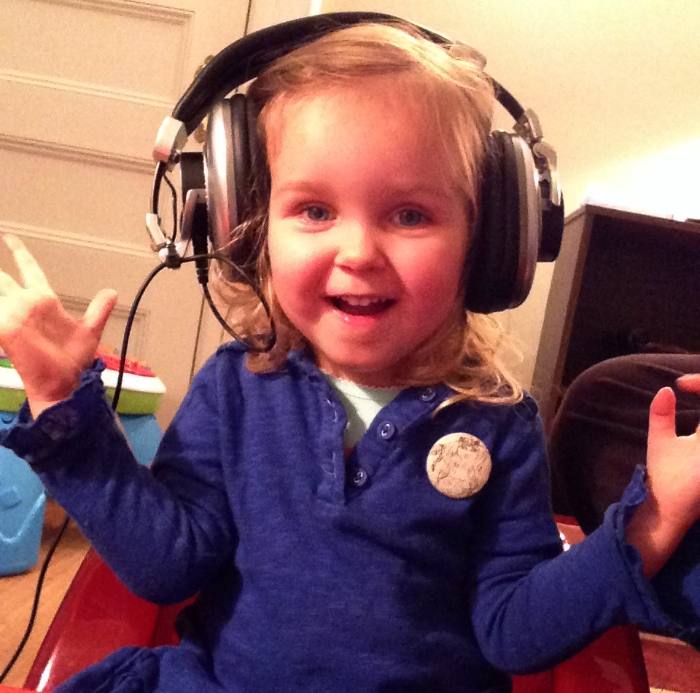
For Enora, we were hoping for effects on speech, on hypersensitivity to noise and perhaps on motor coordination (by acting on the vestibular system, which manages balance and laterality). How? For a month, we had her listen to the Tomatis music every day, gradually increasing the duration (from 20 minutes to 1.5 hours). At first, we paired it with permission to play on the iPad (getting-used-to-it phase), then in the car and in the pushchair.
The results were visible after one week! For 9 months she had only been saying the last syllable of words (“teau” for “gâteau”, “dos” for “sac à dos”), and now we heard the first syllables appear: “gâteau” became “â-teau”, “sac à dos” became “sac-dos”.
After 2 weeks, 3-word phrases appeared: “juice for me”, “mummy, other train”, “I love that”. Enora imitates animal noises more easily.
After 3–4 weeks, verbs and attempts at sentences appeared: “baby drinks b(ott)le”! And we regularly catch Enora talking while playing with her Playmobil (whereas before she played in silence).
Overall very positive: Enora’s speech is more fluent, which shows in more complex speech than before. We also noticed reduced hypersensitivity to noise (the hairdresser managed to dry her hair with a hairdryer: quite a feat!). Of course, there is still a lot to do, as Enora shortens most words by leaving out syllables.
So we did a second Tomatis session! This time, the listening programme was based on the frequency band specific to the French language.
Among the progress noted: many words are gradually becoming complete (“par terre” was pronounced “p-erre” and became “par perre”, “fromage” was pronounced “ma” and became “fro-ma”, etc.), 4-word sentences are more and more frequent, and we heard Enora hum her first nursery rhyme (Bateau sur l’eau)!
Conversations with her are richer and richer. Proof: our latest negotiation:
– “OK, but just have a little bit”
– “No, a big bit!”
Conductive Education
András Pető, a Hungarian doctor, was the first to see disability as an educational challenge rather than a biological or physical problem. Driven by a very humanist philosophy, he created a method called “Conductive Education”. It is based on the idea that children learn motor patterns through everyday activities.


The method is now recognised in many countries. In France, 60 years after it was created, the first Conductive Education programmes appeared. The first school opened in 2009, and since then families have been fighting to open more… Today, 7 French centres practise Conductive Education:
- Honorine Lève-Toi/CEC Bayeux,
- EHM Pouilly-sur-Loire,
- AFPEC Laval,
- SEIMC Maucomble,
- CEC du Gard Clarensac,
- La Maison Escargot Plédéliac
- Le CEC d’Aquitaine Marcheprime
They are represented by the FEPEC (Fédération des Établissements Privés d’Éducation Conductive).

As its name suggests, this method is also an “education” for carers, since children are accompanied by a parent during the sessions, which take place in groups by age and level. The class is also used to motivate. Children are considered as a whole. Unlike conventional therapies, which often focus on one part of the body, everything is worked on here: the physical side of course, but also speech (through singing!) and cognition through crafts. Children are stimulated with games, soap bubbles, nursery rhymes and songs! A routine is established and movements are repeated many times a day, often linked to a song or the same phrase, to create an automatic response in the child (Pavlovian reflex).
Enora T. did her first week of Conductive Education in June 2017 at La Maison Escargot. And she loved it! Group time, workshops on Pető tables (with stretching through play), lunch, osteopathy, library and music therapy. Busy days! Enora worked a lot on crawling and squatting, but above all… she learned to sit on a chair on her own! According to her mum, Conductive Education and the Medek method make a perfect combination.
Another testimony, from Clet. He started Conductive Education at the age of 2 and has had many stays at EHM and La Maison Escargot. There, Clet learned to crawl, was toilet trained, learned to walk with a push walker, to go from sitting to standing…
Vojta method
This method is based on three concepts:
- Muscle chains: as muscles are connected to each other, any localised movement spreads through the body along a defined path.
- Reflex locomotion: it is triggered by pressure applied to specific zones. This produces patterns that are global and innate (reflexes), such as crawling and rolling over.
- Facilitation: maintaining the pressure mentioned above. The physiotherapist “turns” a normally transient movement into a sustained one so that the muscle contraction persists. This way, the brain can recruit more neurons, for longer and in a more appropriate way.
In practice: the practitioner handles the child by pressing specific points on the body in a set direction. The pressure and a body position are held for a given time (a few minutes), then the same exercise is done on the other side. Gradually, the child responds to the pressure by starting a movement; the first muscles used are those of the back and the abdominals. This exercise is active, meaning it requires the child’s participation as far as their age and muscle tone allow.
In our case, Enora “responds” with the physiotherapist but stays completely passive with us when we try to reproduce the exercises at home. So it is hard for us to give an opinion on this method, as we don’t manage to practise it consistently. We still mention it because many families praise its benefits.
Primitive reflex integration method
Primary (or primitive) reflexes are involuntary automatic movements typical of newborns. The paediatrician systematically checks for them at the first medical examination, because they are the foundations of the nervous system and muscle tone. These primary reflexes are mainly controlled by the brainstem.
During the first year of life, they are inhibited and replaced by postural reflexes through voluntary control of movement (a sign that myelination has reached the cerebral cortex). This transition reveals neurological maturity.
A developmental disorder or damage to the nervous system (e.g. cerebral palsy, head injury, stroke, etc.) can lead to primary reflexes persisting or re-emerging, disrupting the acquisition of motor control, neurosensory development and postural reactions. This shows up as difficulties in acquiring various skills: motor skills of course, but also speech, emotional maturity, attention and concentration.
This therapy offers exercises that inhibit persistent primary reflexes.
We were introduced to it by the therapists of the Institut Devenir thanks to the Dominique association: a team of great humanity.
This method did not bring real progress in motor skills, but it opened our eyes to Enora’s personality. What we thought was part of her character actually results from these persistent primary reflexes.
An example? The Moro reflex, sometimes called the infant startle reflex.
It is an automatic response to a sudden change in sensory stimulus: a bright light, a change of position or temperature, a loud noise, intense contact, etc. can trigger the Moro reflex (the child throws both arms out symmetrically while taking a sharp breath, then curls up and starts crying).
The consequences of poor integration are:
- Hypersensitivity
- Lack of emotional and social maturity
- Lack of concentration
- Anxiety
- Hates change or surprises
- Needs to control situations
- Shyness
Dévény method
We have not tried this method directly, but several families have told us how effective it is for spastic children.
Physiotherapist Anna Dévény developed this method of care from 1976. The Dévény Method is also called DSGM (Dévény Special Manual Technique and Gymnastic Method). It consists of removing contractures (shortening of the muscle in response to continued hypertonic stress such as spasticity) to restore the original state of the muscles, ligaments and tissues. It thus corrects incorrect (pathological) body positions.
Removing contractures is the basic condition for correcting movement, because with contracted muscles and tendons, normal movement is impossible. Dévény practitioners consider that active exercise and passive mobilisation (Bobath method) are not enough to overcome contractures.
Make no mistake! The Dévény method is not just a massage technique. Unlike massage, where the body is relaxed, with the Dévény method the muscles and tendons are treated in a stretched position or in motion. The exercises are quite impressive.
Ideally, sessions should be very regular, but it is hard to find a Dévény therapist outside Hungary (in Budapest: deveny@deveny.hu). So some families invite practitioners or go to Hungary for intensive sessions. Parents then have to reproduce (simplified) exercises at home.
Results can be seen in posture (spine), the eyes for strabismus, hand grip and even chewing.