
Cerebral palsy
 Cerebral
In France, this condition is also known as “Infirmité Motrice Cérébrale” (IMC). Cerebral palsy is an umbrella term for disorders of posture and movement coordination caused by the destruction of certain cells during the development of the brain in the foetus or infant (by convention, before the age of 2). As a result, the brain does not send the right commands to the muscles.
Symptoms
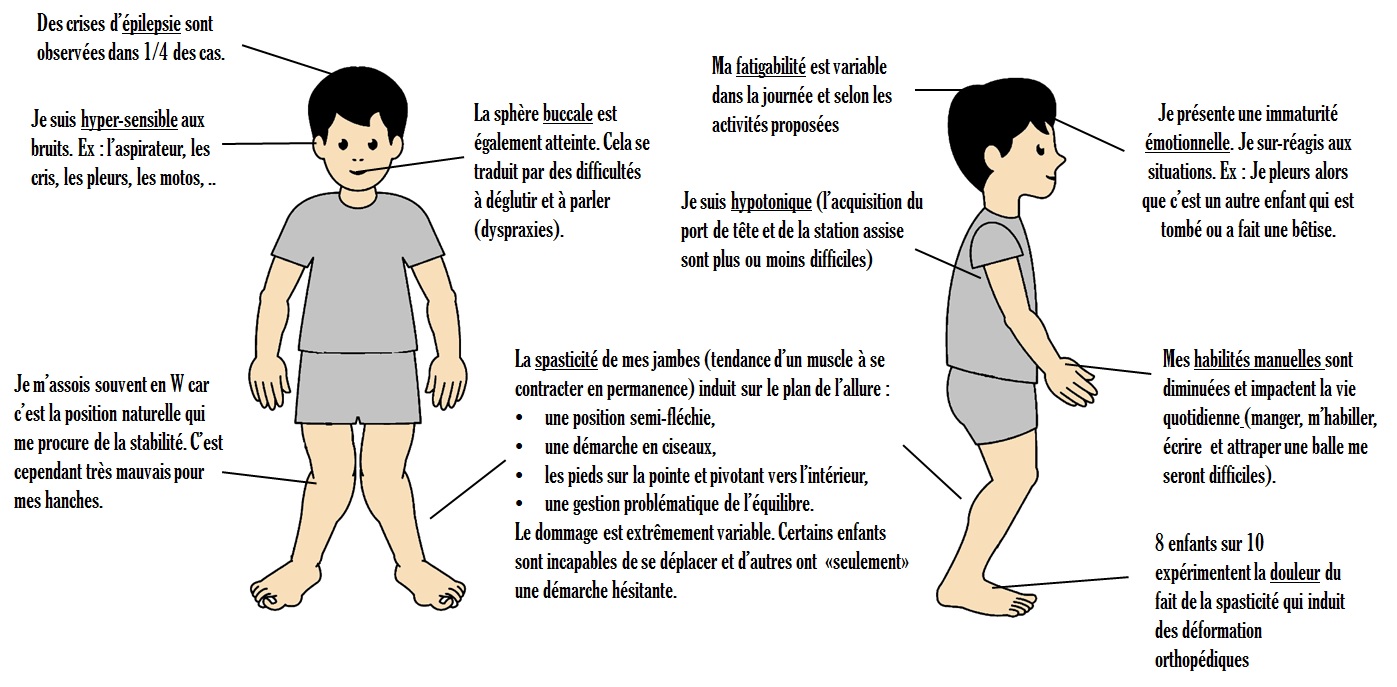
The motor disorders of cerebral palsy are often accompanied by sensory, perceptual, cognitive, communication and behavioural disorders, epilepsy and secondary musculoskeletal problems. All the symptoms shown in the image below may therefore be present, to a greater or lesser extent.
Spasticity
In practice, muscle disorders can be observed: depending on where the lesion is, some muscles are permanently too toned, or not toned enough, or alternate uncontrollably between the two. The main symptom is spasticity : a muscular phenomenon describing a muscle’s tendency to remain permanently contracted. It gets worse when trying to make a movement, but also with cold, emotions and pain! There may also be muscle weakness due to insufficient use of the muscles.
Gait and posture
- a semi-flexed position, because the muscles responsible for flexion are stronger than those responsible for extension;
- a scissor gait: because of tension in the hip muscles, the knees turn inwards;
- the feet are extended onto the toes (bilateral equinus) and turn inwards (varus).
Reflex abnormalities
- Abnormal anti-gravity reactions: poor postural adaptation and difficulty managing balance.
- Poor contralateral weight transfer when lifting a limb. This makes it hard to crawl, move on all fours, stand up, etc. It can be compensated for by voluntary movement.
Proprioception deficit
- Proprioception is the conscious or unconscious perception of oneself in space.
- A proprioception deficit causes problems with positioning the limbs and controlling their tone in relation to the body’s position in space.
The extent of the damage varies enormously from one person to another. The condition can take several forms:
- Spastic diplegia, also known as Little’s disease, when mainly the lower limbs are affected (as in Clet’s case);
- Spastic quadriplegia when all four limbs are affected (as in the case of Enora T. and Zoé);
- Spastic hemiplegia when an arm and a leg on the same side are affected.
Changes over time
A vicious circle sets in with growth… Hence the importance of acting early and continuously.
Cerebral palsy is often described as non-progressive because the damaged area of the brain is fixed. That is true.
But… the child’s growth makes the symptoms very hard to manage, because they change over time.
As the child grows, the permanent contracture of the muscles deforms the bones as they try to grow. Moreover, since the muscle is by nature less flexible and less used than a healthy muscle, contractures develop and the biomechanics of the joints deteriorate. It is therefore a relentless fight against these orthopaedic deformities and the development of poor postures.
Two common examples:
- in young children, spasticity often affects the adductors and leads to a high risk of hip displacement. Hip deformity is accelerated by W-sitting (sitting between the heels), which the child systematically adopts to stabilise themselves when playing on the floor.
- In teenagers, it is not unusual to see motor skills regress, because growth, hormones and the new body shape disrupt what has been achieved.